BRDA Living Data · International
International Supervisory Corpus
How do supervisory priorities differ across the world’s major banking regulators? This panel scores 1,400+ documents from 8 jurisdictions against the same 20-domain topic taxonomy, enabling direct cross-border comparison of regulatory attention for the first time.
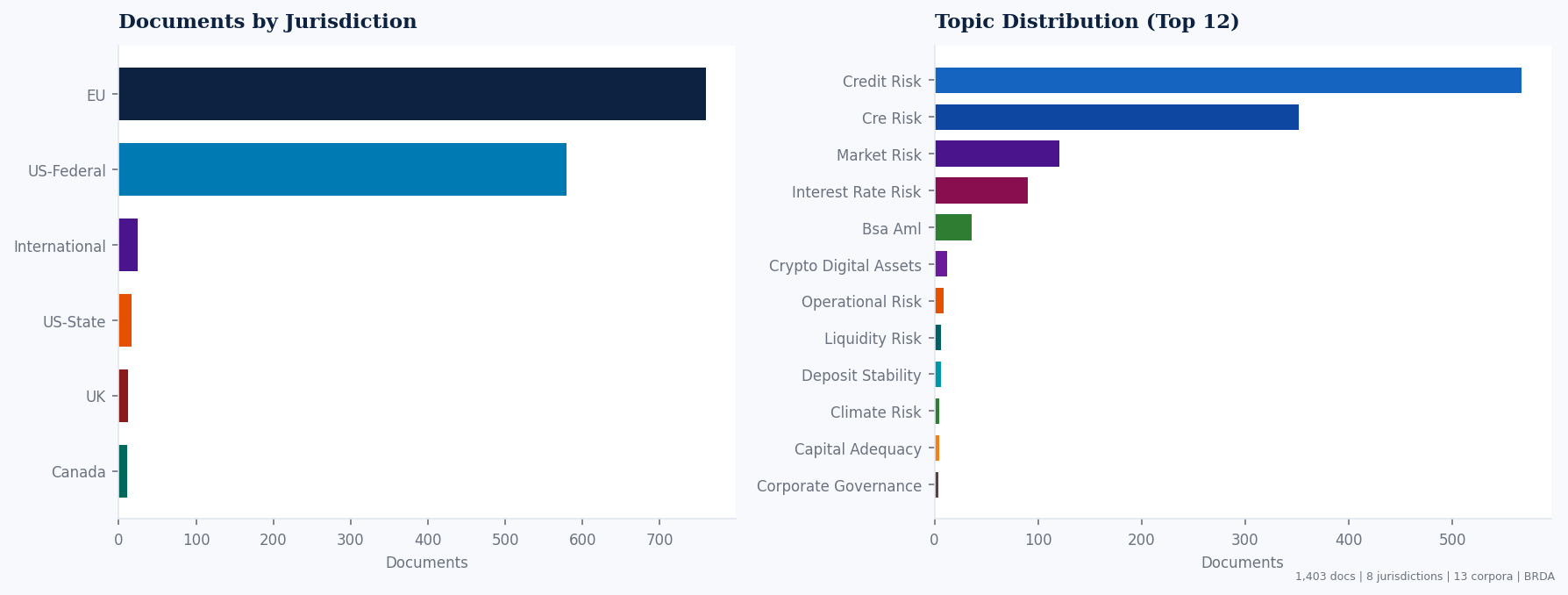
Coverage
| Corpus | Agency | Jurisdiction | Docs | Classification |
|---|---|---|---|---|
| PRA Supervisory | PRA (BoE) | UK | 12 | 99.7% |
| Basel Committee | BCBS | International | 13 | 99.8% |
| OSFI Guidelines | OSFI | Canada | 12 | 100% |
| CSBS Publications | CSBS | US-State | 17 | 99.6% |
| BCBS QIS | BCBS | International | 11 | 98.1% |
| FFIEC BSA/AML | FFIEC | US-Federal | 17 | 90.7% |
| Supervision Handbooks | FDIC/Fed/OCC | US-Federal | 170 | 98.0% |
| OCC Enforcement Text | OCC | US-Federal | 375 | 98.0% |
| EBA Transparency | EBA | EU | 480 | 76% |
| EBA Stress Tests | EBA | EU | 280 | 77% |
Extraction Pipeline
Every document passes through a three-layer extraction pipeline designed to maximize deterministic coverage while using local LLMs only for the residual 5–15% of text that keyword scoring cannot resolve:
- Python/pdfplumber — PDF text extraction with section-aware chunking (500-word target, heading detection)
- Deterministic keyword scoring — 30+ discriminating terms per domain, 87–100% chunk classification rate
- Local LLM inference — Ollama qwen3:30b for unresolved chunks, 97% hit rate on the residual
White Paper: Regulatory Contagion
When one jurisdiction tightens supervision on a risk domain, how quickly do others follow? This panel provides the first systematically comparable measurement of topic-level supervisory attention across major banking jurisdictions. Combined with the adoption-lag panel, it enables direct estimation of regulatory propagation speeds and identification of “first-mover” vs. “follower” agencies on emerging risks like climate, crypto, and operational resilience.
Applications: Cross-border supervisory gap analysis, regulatory arbitrage detection, international coordination measurement, emerging-risk early warning