BRDA Living Data · Cross-Agency Coordination
Cross-Agency Coordination
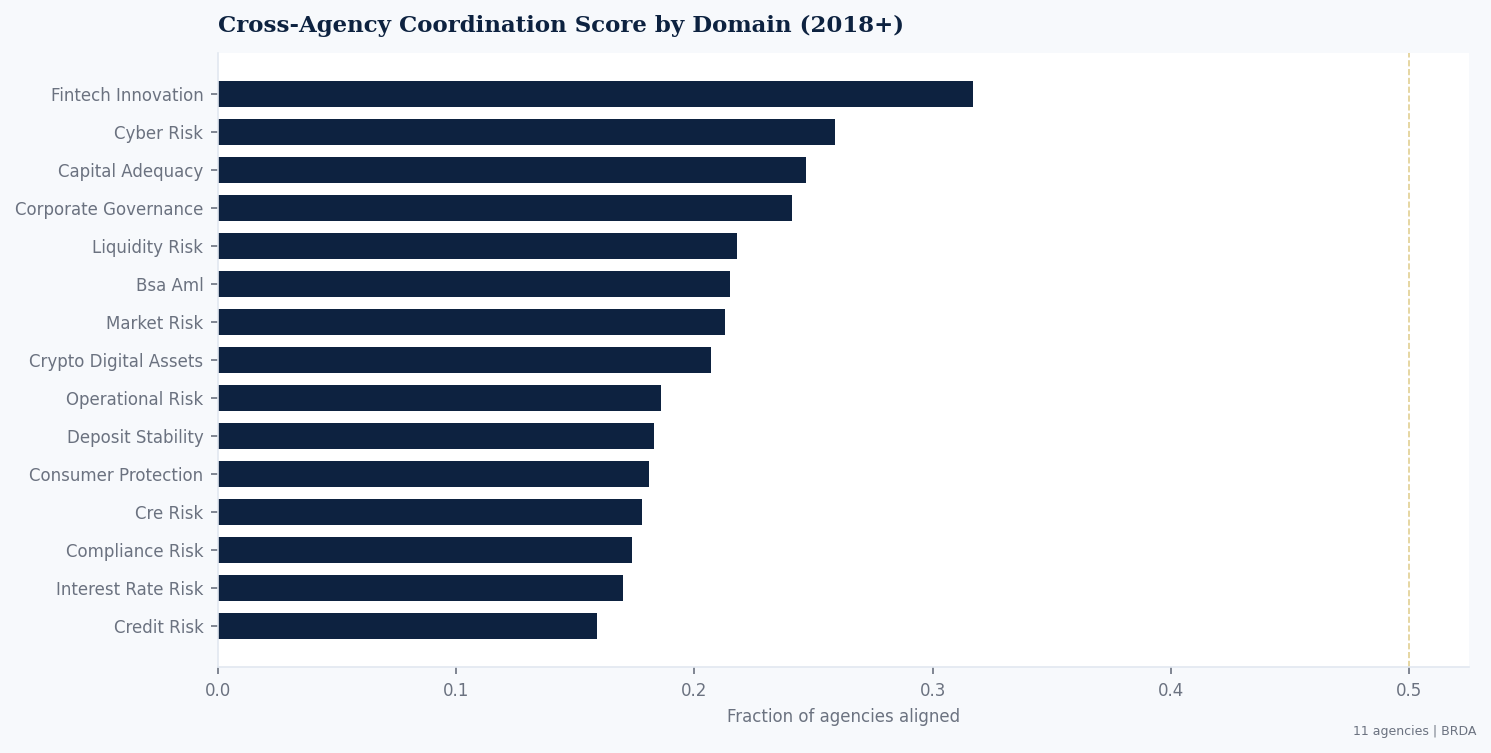
This panel measures when multiple agencies write about the same policy domain in the same quarter. High coordination scores indicate aligned regulatory attention — possibly driven by shared risks, joint rulemakings, or synchronized examination cycles. A score of 1.0 means all four agencies mention the domain; 0.25 means only one does.
Average coordination score over time
Mean coordination score across all 20 policy domains by year. Higher values indicate more agencies simultaneously attending to the same topics. The shaded band shows a 3-year centered moving average.
Coordination by domain
Which policy domains attract multi-agency attention, and when? Darker cells indicate higher coordination scores — more agencies focusing on the same topic in the same year.
Multi-agency spotlight
Domains where three or more agencies focus simultaneously. The bar chart counts the number of year-quarters in which each domain attracted coordinated attention from at least three of four agencies.
Domain detail
Select a specific policy domain to trace its coordination score over time. The label shows which agencies mentioned the domain in each year-quarter.
White Paper: Regulatory Orchestration
Is multi-agency coordination deliberate or emergent? When all four banking agencies focus on the same topic in the same quarter, is it because they share information — or because they independently respond to the same macro shock? This panel provides the coordination scores and agency-overlap timing needed to distinguish orchestrated from reactive supervisory alignment.
Applications: Inter-agency coordination measurement, supervisory synchronization testing, policy diffusion modeling, regulatory gap detection